Such stability...
If the British state system can't even deliver the one thing it's meant to be good at, what's it for?

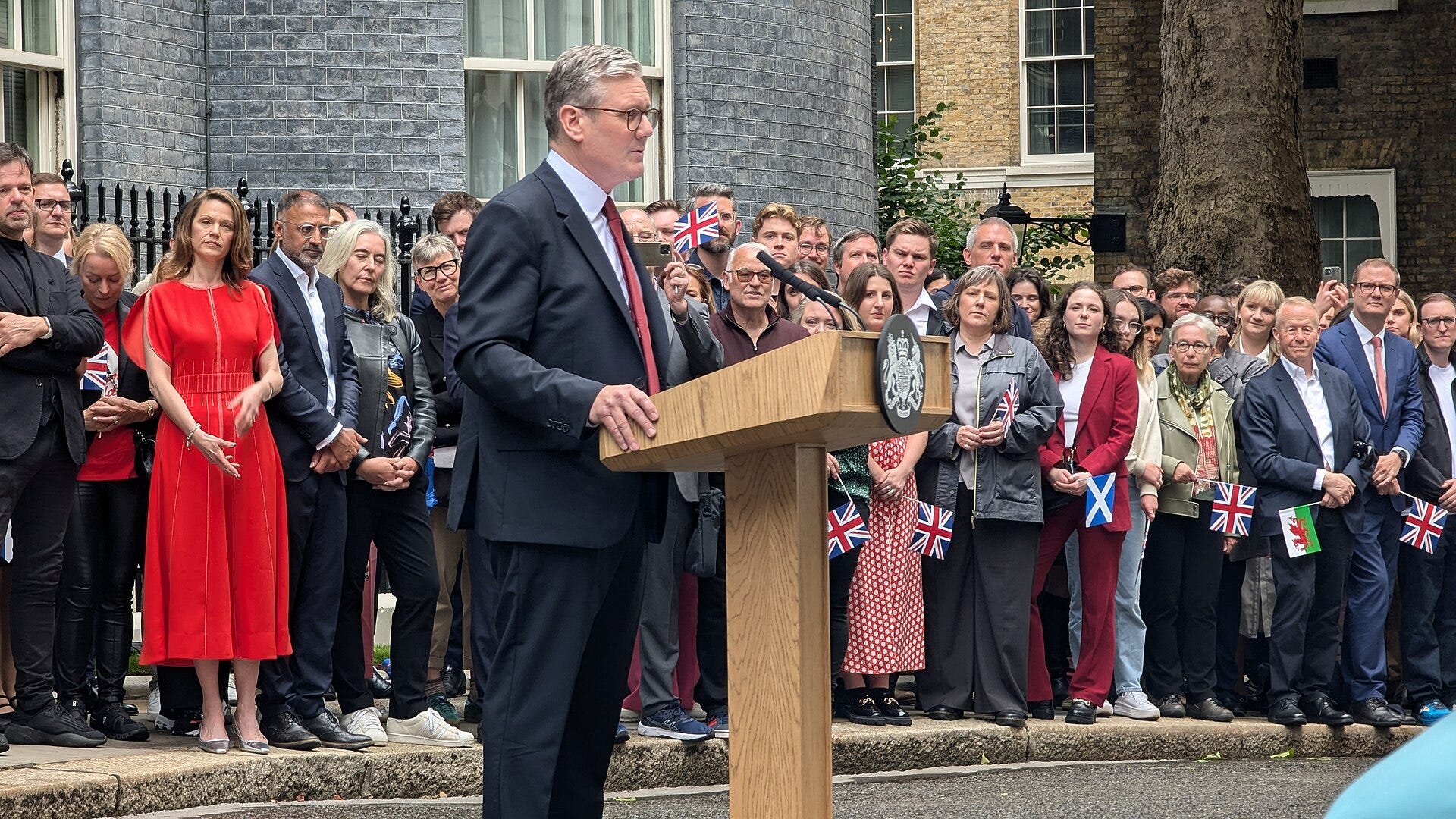
It’s tantalisingly close. David Cameron stood down as prime minister on 13 July 2016. If Labour manages to replace Keir Starmer before 13 July this year, Britain will have had seven prime ministers in ten years - the same number Italy had across the 1990s.
Whether or not we hit that record, though, it’s worth taking a moment to ponder the obvious question. The British political system used to be seen as stable. First past the post may not be very democratic, its defenders would accept, but at least it produced clear winners who could become strong leaders, and govern the country - unlike the “chaos” seen in some of our European neighbours.
The stable majorities produced by first past the post - the argument continued - were then further reinforced by the way that our legislature and executive are fused. Where other countries have a separation of powers, the 19th century constitutional theorist Walter Bagehot praised the “efficient secret” of the British constitution - which, he said, was “the near complete fusion” of the legislature and the executive, with the prime minister and cabinet atop both.
Where, in the US, battles between Congress and the White House produce budget stalemates and lockdowns, British cabinets generally expect their finance bills to sail through parliament. Defeats of government proposals in general are rare. In reality, it’s unusual for any legislation at all to pass without the nod from the governing party: our MPs have relatively little power, compared to their equivalents in other democracies.
On the big questions, the judiciary is relatively weak. Most countries have written constitutions and top-courts holding the executive to account. In Britain, “the Crown in Parliament” is sovereign - a power, in practice, largely wielded by prime ministers with majorities secured through first past the post and the aggressive whipping system.
Similarly, power is radically centralised. In Britain, a much higher portion of public money is spent by the national government rather than local or regional governments than in any other major democracy.
Compared to other democratic systems, our whole setup is designed to discourage dissent within ruling parties, prevent alternative bases of power, grant vast, king-like control to prime ministers, and let them get on with it. The downsides - disempowering the public, the risk of overly strong prime ministers, the capacity for corporate capture of such a centralised, undemocratic state - are clear. There is only one supposed upside, which the advocates of the British system used to loudly trumpet: stability.
Well, where is that stability now?
As we lurch towards our seventh prime minister in a decade, or just over, as the first ministers in Scotland, Wales and Northern Ireland gather to sketch out their exit routes from the UK, as popularity of the monarchy dwindles, and trust in the system hits record lows, what does our unique, ancient constitutional arrangement have to say for itself?
A simple way to understand what’s happened is that, for decades, British people accepted the relative lack of democracy in our state system because it delivered wealth for all of us, to differing extents - first, through the plunder of colonialism, and then, through the secondary benefits of late imperialism, that is, financialisation, and the income we got from renting or selling the assets built up through empire.
We were willing to put up with the disempowerment of living under an empire state because most of us, to some extent, benefited from its empire.
As British power has dwindled, we only see the costs. We have all of the disempowerment, the alienation it produces, the rise of the far right, conspiracy thinking and moral panics which go with it, but we don’t even get income streams and stable governments anymore.
There are, of course, other stories you can tell about the collapsing faith in our political system. But they generally lead to the same question: what are we going to do about it?
You have just made the case for a written constitution. See my book Reinventing Democracy.
STEADY AS SHE SINKS…